

Smart Irrigation Market Surpasses USD 1.78 Billion in 2025, Eyes USD 5.78 Billion by 2035
Smart Irrigation Market
Smart Irrigation Market Size, Share and Research Report By Component (Controllers, Sensors, Water Flow Meters, Others), By System Type (Weather Based Controller
Smart Irrigation Market: Smart irrigation technologies optimize water usage through automated, sensor-based and data-driven irrigation systems.”
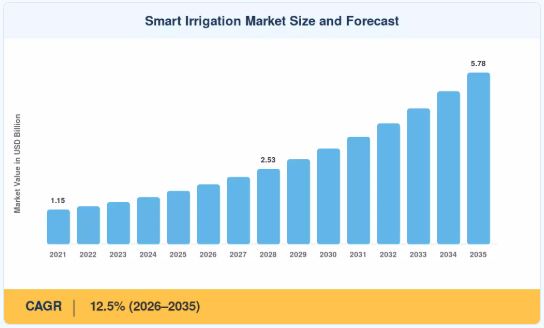
TEL AVIV, TEL AVIV, ISRAEL, August 12, 2026 /EINPresswire.com/ -- The Global Smart Irrigation market was valued at USD 1.78 billion in 2025 and is projected to grow from USD 2.00 billion in 2026 to USD 5.78 billion by 2035, registering a CAGR of 12.5% during the forecast period 2026–2035. Two catalysts are accelerating this trajectory: the U.S. EPA's expanded WaterSense program, which now covers commercial irrigation controllers, and the European Commission's revised Water Framework Directive requiring member states to cut agricultural water consumption by 15% before 2030. — Market Research Future (MRFR)
These policy mandates are converting what was once a voluntary efficiency upgrade into a compliance-driven investment cycle. The market's 12.5% CAGR reflects the convergence of freshwater scarcity and drought regulation (+2.8% impact), government subsidy programs for micro-irrigation (+2.2%), IoT and cloud platform cost reduction (+2.0%), and precision agriculture expansion (+1.8%) accelerating across the world's most water-stressed agricultural and commercial-landscaping economies simultaneously.
A technological shift is well underway across the market. Legacy timer-based controllers still running on roughly 60% of irrigated commercial landscapes in North America are being replaced by sensor-driven, cloud-connected platforms that adjust watering schedules in real time based on soil conditions, evapotranspiration rates, and hyper-local weather feeds. California's Department of Water Resources allocated USD 180 million in 2024 alone for agricultural water-efficiency retrofits, a figure that signals the scale of public capital flowing into this transition.
North America commands the largest share of the market at approximately 35% of global revenue, driven by drought-prone western U.S. states and mature distribution channels. Asia-Pacific is the fastest-growing region with an estimated CAGR of 14.8%, propelled by India's Pradhan Mantri Krishi Sinchayee Yojana micro-irrigation subsidies and China's digital agriculture push. Europe holds the second-largest share at 27%, anchored by Mediterranean water-scarcity mandates. The decade ahead will reshape how water is managed across every irrigated surface on the planet.
Get Full PDF Sample Copy of Report: (Including Full TOC, List of Tables & Figures, Chart) @
https://www.marketresearchfuture.com/sample_request/2529
➤ How Significant Is the Smart Irrigation Market's Growth?
The smart irrigation market's trajectory from USD 1.78 billion in 2025 to a projected USD 5.78 billion by 2035 represents more than a three-fold expansion over the forecast decade, reflecting the structural shift from timer-based watering toward sensor-driven, cloud-connected platforms that treat every irrigated surface as a data-optimized system. The market's 12.5% CAGR is anchored in a water-scarcity-and-policy supercycle where drought regulation, government micro-irrigation subsidies, and falling IoT hardware costs are all converging to make connected irrigation a compliance-driven necessity rather than a discretionary efficiency upgrade.
Sensor-based irrigation systems held the dominant share of the market in 2025, capturing approximately 48% of total revenue, while weather-based controller systems are forecast to register a CAGR of 13.1% through 2035, driven by declining satellite data subscription costs, and hybrid systems combining sensor and weather inputs accounted for an estimated USD 320 million in 2025.
By application, agricultural applications represent the largest revenue pool with roughly a 58% share, while non-agricultural applications including commercial landscaping, golf courses, and municipal parks are growing at a 13.4% CAGR. By component, controllers hold a 36% share in 2025 as the central decision-making unit named directly in regulatory mandates, while software and platforms are growing fastest at a 15.8% CAGR as vendors pivot toward recurring-revenue subscription models.
➤ What Does the Future Hold for the Smart Irrigation Market?
Freshwater scarcity and drought regulation contribute approximately +2.8 percentage points to the smart irrigation market's CAGR the single highest driver impact. According to the UN World Water Development Report 2024, over 2.3 billion people worldwide suffer from water stress, and almost 70% of freshwater withdrawals are used for agricultural irrigation.
Regulations are becoming more stringent, with Arizona's Groundwater Management Act amendments and California's Senate Bill 1383 setting metered allocation restrictions on commercial irrigators, while the European Commission's 2024 Water Reuse Regulation only permits treated wastewater in agriculture when combined with authorized sensor-monitored distribution systems, effectively shutting legacy timer-based installations out of the reclaimed-water supply chain.
Government subsidy programs for micro-irrigation contribute approximately +2.2 percentage points to the CAGR, establishing public capital as a primary structural demand source. Since 2015, India's PMKSY program has disbursed more than USD 3.5 billion for micro-irrigation infrastructure, with Phase III designating funds exclusively for 10 million hectares of IoT-enabled drip and sprinkler systems, while over USD 420 million in irrigation-related claims were received in fiscal year 2024 under USDA's Environmental Quality Incentives Program, which reimburses qualifying farms up to 75% of smart irrigation controller costs. IoT and cloud platform cost reduction adds a further +2.0% to the CAGR as the average cost of a commercial-grade soil moisture sensor dropped from USD 185 in 2019 to approximately USD 68 in 2025, a 63% decline that makes connected irrigation economically viable for mid-tier commercial landscapers and smallholder farms previously priced out of the market.
The next phase of the market's evolution centers on AI-autonomous irrigation networks, with systems requiring zero human input for day-to-day scheduling decisions expected to move from pilot to mainstream deployment by 2030, fusing satellite spectral imagery, ground-sensor telemetry, and probabilistic weather models through reinforcement-learning algorithms.
The market is also shifting from a hardware-sales model to a platform-economics model, with vendors like Rain Bird and Toro building open-API cloud platforms that integrate third-party sensors, weather services, and agronomic advisory modules; recurring software and data-service revenue is expected to account for 25–30% of leading vendors' irrigation-segment income by 2028. Sustainability reporting mandates such as the EU's Corporate Sustainability Reporting Directive, effective 2025, require large companies to disclose water-use metrics across their supply chains, a task practically impossible without connected sensor infrastructure, creating a demand driver independent of commodity prices or weather cycles.
Get access to the full description of the report @
https://www.marketresearchfuture.com/reports/smart-irrigation-market-2529
➤ Who Are the Key Players in the Smart Irrigation Market?
The smart irrigation market is moderately concentrated, with an estimated Herfindahl-Hirschman Index below 1,500 and the top five players collectively holding approximately 40–45% of global revenue. The competitive field spans large diversified irrigation corporations, specialized smart-technology startups, and agricultural conglomerates entering through acquisition, with differentiation increasingly hinging on software capabilities and ecosystem breadth rather than hardware specifications alone. MRFR identifies the following key participants with estimated revenue share ranges:
Rain Bird Corporation (~8–11% share) - a full-stack residential and commercial solutions provider offering ESP-TM2 controllers and the IQ4 central control platform, having launched an open-API cloud platform targeting commercial landscape operators managing 50-plus sites.
The Toro Company / Irritrol (~7–10% share) - an integrated turf and landscape management leader providing Evolution series controllers and Lynx central control, having acquired a soil-sensing startup to add real-time root-zone moisture monitoring across turf and agricultural applications.
Hunter Industries (~7–9% share) - a cloud-native residential and light commercial specialist providing HC Hydrawise controllers and soil-clik sensors, having introduced the HC Pro commercial controller with built-in cellular connectivity and multi-site remote management.
Netafim / Orbia (~6–8% share) - the global precision agriculture leader providing the NetBeat digital farming platform and precision drip systems, having partnered with a major satellite imagery provider to integrate crop-canopy analytics for prescription-based irrigation scheduling.
Lindsay Corporation (~4–6% share) - a large-scale pivot and lateral irrigation specialist providing FieldNET Advisor and Zimmatic pivot controls, serving commodity-crop operations requiring wide-area variable-rate irrigation management.
Galcon (~2–4% share) - a greenhouse and fertigation automation specialist providing GSi controllers with FertiGal integration, serving controlled-environment agriculture and precision fertigation applications.
Rachio (~2–3% share) - a direct-to-consumer residential smart home specialist providing the Rachio 3 smart sprinkler controller, having released a firmware update incorporating NOAA hourly forecast data that reduced average residential water use by an estimated 15%.
HydroPoint Data Systems (~2–3% share) - a commercial landscape water management specialist providing WeatherTRAK controllers and baseline management tools, serving large multi-site commercial and municipal customers.
CropX Technologies (~1–3% share) - a data-driven farm advisory services provider offering a soil sensing platform and agronomic analytics, positioned at the intersection of hardware and subscription-based advisory revenue.
Weathermatic (~1–2% share) - a commercial landscape and municipal parks specialist providing SmartLink controllers and the SL series, serving property managers subject to green building water-efficiency certification requirements.
Strategic competition in the smart irrigation market is increasingly defined by open-API ecosystem breadth and recurring software revenue with high upfront installation and integration costs cited as a top adoption barrier, as a fully integrated system for a 500-acre farm can cost between USD 45,000 and USD 75,000, alongside fragmented rural connectivity affecting nearly 40% of farmland in Sub-Saharan Africa and 25% in South and Southeast Asia, a scarcity of trained personnel for system maintenance and calibration, and data privacy and cybersecurity concerns around cloud-connected controllers.
➤ What Are the Emerging Trends in the Smart Irrigation Market?
Several transformational trends are redefining the smart irrigation market's evolution through 2035:
Freshwater Scarcity and Drought Regulation: Arizona's Groundwater Management Act amendments, California's Senate Bill 1383, and the EU's 2024 Water Reuse Regulation are converting controller upgrades from voluntary efficiency measures into compliance requirements as over 2.3 billion people worldwide face water stress.
Government Subsidy Programs: India's PMKSY program has disbursed more than USD 3.5 billion for micro-irrigation infrastructure, while USDA's EQIP program reimburses qualifying U.S. farms up to 75% of smart irrigation controller costs, cutting payback timeframes from five years to under two.
IoT and Cloud Platform Cost Reduction: Commercial-grade soil moisture sensor costs fell 63% from USD 185 in 2019 to approximately USD 68 in 2025, while cloud computing costs for real-time data ingestion dropped roughly 40% over the same period, making connected irrigation viable for smallholder farms.
Emerging-Market Leapfrog via Mobile-First Platforms: Vendors building SMS- and app-based controller interfaces requiring no desktop or browser can unlock a market of over 450 million smallholder farms globally, with companies like Jain Irrigation and CropX demonstrating 20% water savings at system costs under USD 200 per hectare.
Smart City Green Infrastructure Mandates: Cities including Singapore, Dubai, and Los Angeles have enacted green building codes requiring connected irrigation for commercial landscapes above specified thresholds, with Singapore's Building and Construction Authority mandating smart landscape management for all developments above 5,000 square meters.
Buy Full Research Report:
https://www.marketresearchfuture.com/checkout?currency=one_user-USD&report_id=2529
➤ How Is the Smart Irrigation Market Segmented?
The smart irrigation market report provides a comprehensive segmentation framework:
By System Type: Sensor-Based Systems (48% share, 2025), Weather-Based Systems (13.1% CAGR), Hybrid Systems (USD 0.32 billion, 2025)
By Component: Controllers (36% share, 2025), Sensors (14.2% CAGR), Water Flow Meters (USD 0.18 billion, 2025), Software & Platforms (15.8% CAGR)
By Application: Agricultural — Greenhouse, Open Field (58% share, 2025), Non-Agricultural — Residential, Turf and Landscape, Golf Courses, Others (13.4% CAGR)
By Region: North America (35%), Europe (27%), Asia-Pacific (14.8% CAGR), South America (USD 0.14 billion, 2025), Middle East & Africa (13.9% CAGR)
➤ What Are the Regional Insights from the Smart Irrigation Market?
North America commands the largest share of the smart irrigation market at approximately 35% of global revenue, with the United States driving 82% of regional share through a combination of stringent water-use regulations and a well-established distribution network. California's Model Water Efficient Landscape Ordinance requires weather-based or sensor-based irrigation controllers for all new commercial developments, with similar ordinances spreading to Arizona, Colorado, and Texas, while EPA WaterSense rebate partnerships span over 1,800 utilities nationwide. Canada is growing at an 11.8% CAGR through municipal landscaping codes and turf management, and Mexico contributed USD 0.03 billion through export agriculture water-efficiency requirements.
Europe holds the second-largest share of the smart irrigation market at 27%, with growth tightly coupled to the Common Agricultural Policy 2023–2027 reform, which conditions direct payments on demonstrable water-efficiency measures. Spain commands 28% of regional share as it faces chronic water deficits in Andalusia and Murcia, Italy is growing at a 13.2% CAGR through precision viticulture where water stress management directly influences wine quality and pricing, France contributed USD 0.08 billion through its AgriTech startup ecosystem, and Germany is growing at an 11.5% CAGR through smart landscaping for commercial properties, with EU Horizon Europe grants worth EUR 95 million earmarked for digital water management research through 2027.
Asia-Pacific represents the most dynamic growth frontier for the smart irrigation market, posting an estimated 14.8% CAGR and projected to reach USD 1.62 billion by 2035. India commands 38% of regional share through its PMKSY program, the single largest government irrigation subsidy globally, targeting 10 million hectares of micro-irrigation coverage by 2029. China is growing at a 15.2% CAGR as its Ministry of Agriculture has embedded smart irrigation in its 14th Five-Year Plan for agricultural modernization, with pilot projects covering 3 million hectares in Xinjiang and Henan provinces, Australia contributed USD 0.09 billion through its Murray-Darling Basin water-trading framework, and Japan is growing at a 10.8% CAGR through aging-farmer automation and rice-paddy management.
South America and the Middle East & Africa round out the smart irrigation market's regional footprint, with the latter posting the second-highest regional CAGR at 13.9% due to acute freshwater scarcity. Brazil commands 65% of South American revenue as the world's largest soybean exporter, with Embrapa partnering with Israeli irrigation technology providers to deploy sensor networks across 500,000 hectares of pilot farmland, while Argentina is growing at a 12.8% CAGR through Pampas grain-belt modernization. In the Middle East & Africa, Saudi Arabia commands 34% of regional share as its Vision 2030 program has allocated over USD 2 billion for agricultural technology with smart irrigation identified as a food-security priority, the UAE is growing at a 14.5% CAGR through controlled-environment agriculture mandates, South Africa contributed USD 0.02 billion through commercial farming drought adaptation, and Kenya is growing at a 15.1% CAGR through smallholder mobile-first irrigation platforms backed by World Bank and AGRA co-funded pilots pairing solar-powered pumps with SMS-based soil monitoring.
➤➤➤ Industry Analysis Reports by Market Research Future:
Carbon Capture And Storage (Ccs) Services Market
https://www.marketresearchfuture.com/reports/carbon-capture-and-storage-ccs-services-market-66141
Carbon Credit Trading And Consulting Services Market
https://www.marketresearchfuture.com/reports/carbon-credit-trading-and-consulting-services-market-66145
Chemical Analysis And Testing Services Market
https://www.marketresearchfuture.com/reports/chemical-analysis-and-testing-services-market-66171
Chemical Packaging And Labeling Services Market
https://www.marketresearchfuture.com/reports/chemical-packaging-and-labeling-services-market-66181
Chronic Disease Management Services Market
https://www.marketresearchfuture.com/reports/chronic-disease-management-services-market-66199
Climate Change And Adaptation Consulting Services Market
https://www.marketresearchfuture.com/reports/climate-change-and-adaptation-consulting-services-market-66206
Climate Risk And Resilience Consulting Services Market
https://www.marketresearchfuture.com/reports/climate-risk-and-resilience-consulting-services-market-66208
Cloud Security Consulting Services Market
https://www.marketresearchfuture.com/reports/cloud-security-consulting-services-market-66221
Compensation And Benefits Consulting Services Market
https://www.marketresearchfuture.com/reports/compensation-and-benefits-consulting-services-market-66269
Construction Management And Planning Services Market
https://www.marketresearchfuture.com/reports/construction-management-and-planning-services-market-66299
Sagar Kadam
Market Research Future
+ +1 628-258-0071
email us here
Legal Disclaimer:
EIN Presswire provides this news content "as is" without warranty of any kind. We do not accept any responsibility or liability for the accuracy, content, images, videos, licenses, completeness, legality, or reliability of the information contained in this article. If you have any complaints or copyright issues related to this article, kindly contact the author above.
